Control the signal.
Choose the transmission-line geometry. Preserve the return path. Budget for launches, matching networks, coupling and test access.
MicrostripGroundingStackup
RF engineering, made practical
From your first 50 Ω trace to a production-ready stackup. Explore materials, calculate geometry, and design a clearer path to fabrication.
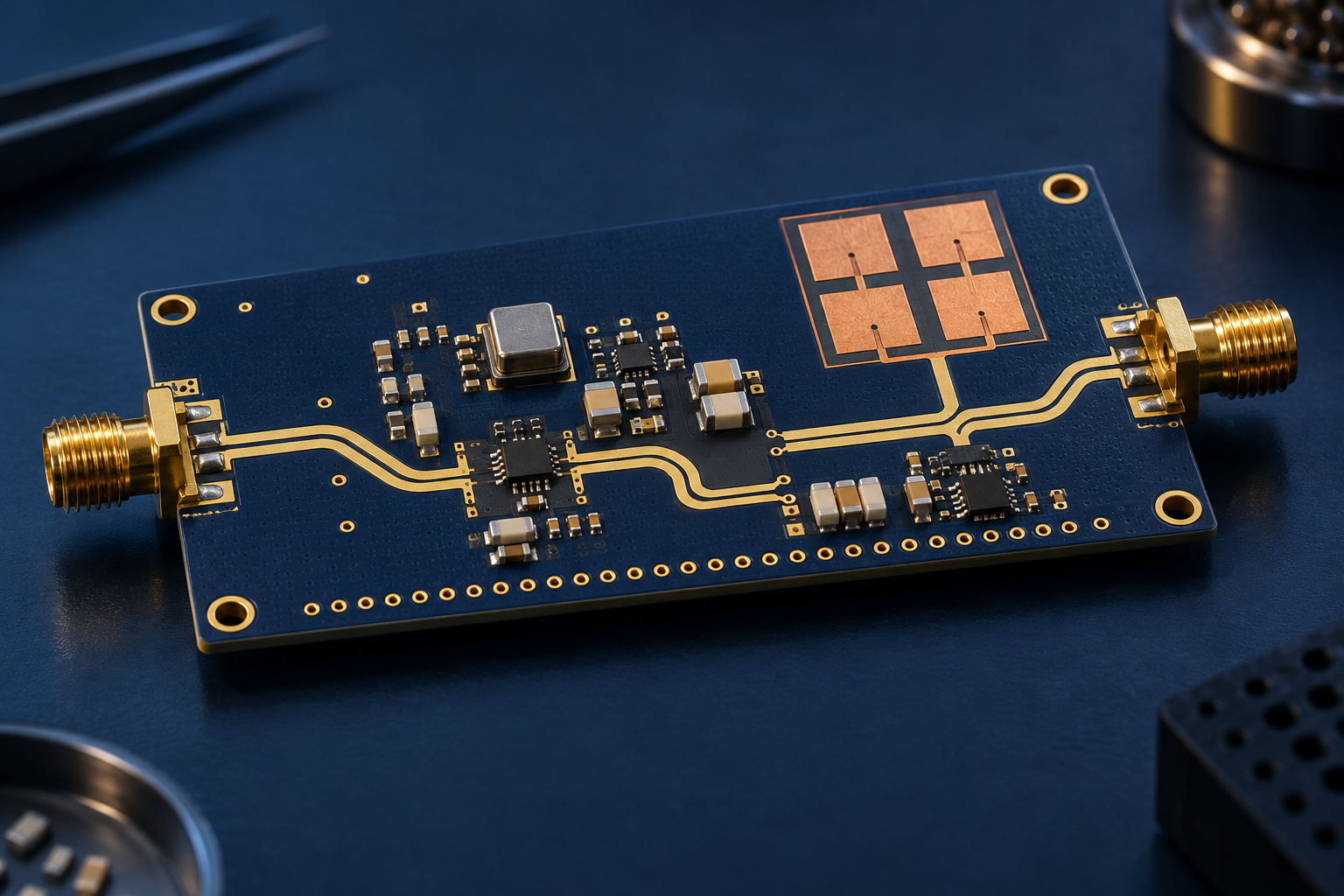
01 / A connected workflow
RF PCB design connects circuit intent, electromagnetic behavior and fabrication tolerances. Make those decisions together.
Choose the transmission-line geometry. Preserve the return path. Budget for launches, matching networks, coupling and test access.
Compare material families by their role in your board. Separate process Dk from design Dk, and check loss against the actual operating band.
Translate your design into an unambiguous release package: approved stackup, copper specification, impedance targets and inspection evidence.
02 / The RF workbench
Change the geometry and see what happens. Use this RF PCB design tool to explore a first-pass microstrip before detailed simulation.
01 / Microstrip calculator
Estimate impedance, or solve the trace width for a target.
Use a design Dk appropriate to your laminate, construction and frequency. The 3.66 default is an example, not a universal laminate value.
Characteristic impedance
Hammerstad–Jensen quasi-static microstrip model; zero copper thickness, no solder mask, no dispersion or loss correction. Isolated microstrip only—not grounded coplanar waveguide. Validate the final geometry with your fabricator and an appropriate field solver. Model reference ↗
03 / Materials, with context
RF cores, digital laminates, flexible films and embedded resistor foils solve different problems. Start with the function.
| Material family | Typical design question | What to verify | Explore |
|---|---|---|---|
| Rogers RO4000 series | How do I balance RF loss and fabrication process? | Design Dk, copper profile, thickness | Rogers materials ↗ |
| AGC / Taconic RF laminates | Which RF laminate fits my stackup and loss budget? | Grade, bonding system, available construction | AGC materials ↗ |
| Isola high-performance laminates | How should RF and high-speed digital coexist? | Frequency-dependent properties and glass style | Isola materials ↗ |
| Panasonic MEGTRON / FELIOS | Does this layer need low loss or flexibility? | Exact part number and laminate construction | Panasonic materials ↗ |
04 / Design around the application
Connect layout decisions to the antenna, enclosure, bandwidth, power and test conditions of your product.
Feed networks, launch transitions and channel consistency.
Keepouts, feed geometry and enclosure-aware tuning.
Compact layouts, matching options and coexistence.
Multi-band placement, isolation and return paths.
Loss budgets, thermal behavior and phase stability.
Dense RF routing and multi-channel integration.
Power, grounding, thermal paths and stability.
Repeatable interfaces, fixtures and calibration.
05 / From layout to fabrication
Manufacturing quality starts with shared requirements. Agree on what will be built and how it will be verified.
Operating bands, loss budget, board outline, temperature range, quantity and expected validation.
Specify laminate grades, finished copper, pressed dielectric thickness and impedance geometry.
Check drill structures, annular rings, etch limits, launch features, surface finish and panel needs.
Agree on electrical test, impedance coupons, inspection records and RF prototype measurements.
Additional fabrication perspectives: high-frequency PCB fabrication considerations and RF board manufacturing and stackup options.
06 / Understand the cost
Material, construction, yield and test requirements matter more than a single price per square inch. Explore the variables, then request a quote against a defined fabrication package.
Build a better RFQ ↗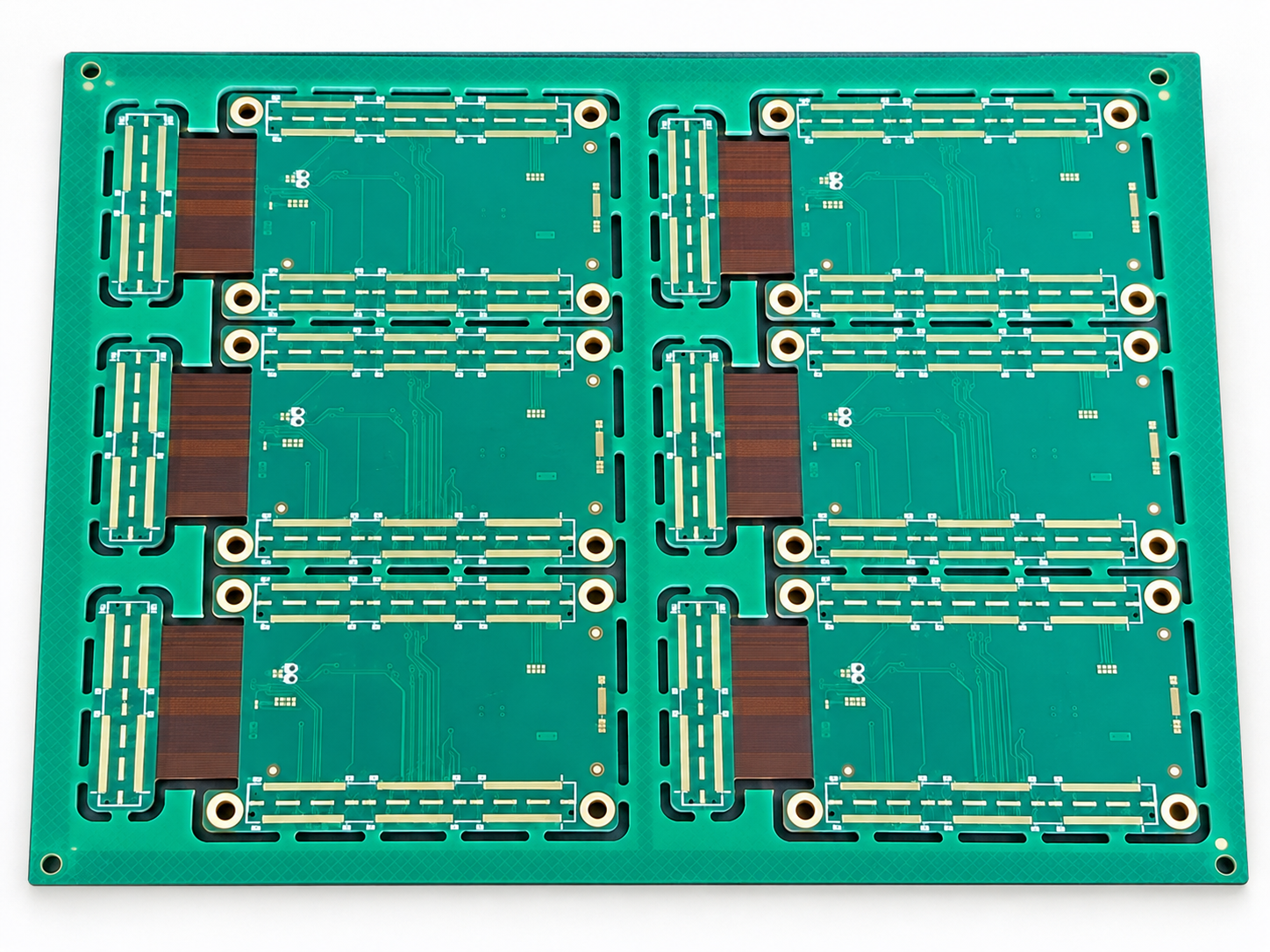
Construction matters
Flexible sections, connectors and mechanical boundaries can change the RF path. Plan the assembled shape alongside the electrical stackup, and keep the transition into each rigid region part of the review.
07 / Questions from the workbench
RF PCB design is the process of controlling the electrical and electromagnetic behavior of a printed circuit board at radio frequencies. It includes transmission-line geometry, return paths, material selection, isolation, matching and a plan to measure the assembled result.
Sometimes. The decision depends on trace length, frequency, permitted loss, tolerance and the antenna or circuit architecture. Short 2.4 GHz interconnects may be workable on an appropriate FR-4 construction, while a long phase-critical feed network can justify a dedicated RF laminate.
No. A first-pass calculation does not include every practical detail. Copper thickness, solder mask, nearby ground, launches, etched shape and manufacturing tolerances all affect the result. Align the geometry with the fabricator and verify critical structures with simulation and measurement.
Share the operating band, outline, intended stackup, required quantity and your main design concern. Gerber files, drill data, fabrication notes and drawings help when available, but attachments are optional. You can request an NDA discussion before sharing sensitive design files.
Compare an all-RF construction with a manufacturable hybrid stackup, avoid unneeded tolerances, choose available laminate constructions, improve panel utilization and define only the special processes your design actually needs. Recheck electrical behavior after any material or geometry change.
Your next RF board starts here
Tell us what you are building, the frequency range and where you need help. Drawings are useful, but never required to start.
Design review · Material selection · Manufacturing requirements
Use the project form for all inquiries. Discuss an NDA before uploading confidential files if needed.
This inquiry form is temporarily unavailable. Please contact us directly.
Engineering notebook
Oct 8, 2026
Review the antenna region as part of the assembled product, not just the top copper layer.
Oct 8, 2026
Understand why a material data sheet can provide more than one dielectric-constant value.
Oct 8, 2026
A practical checklist for the information that should travel with an RF fabrication package.